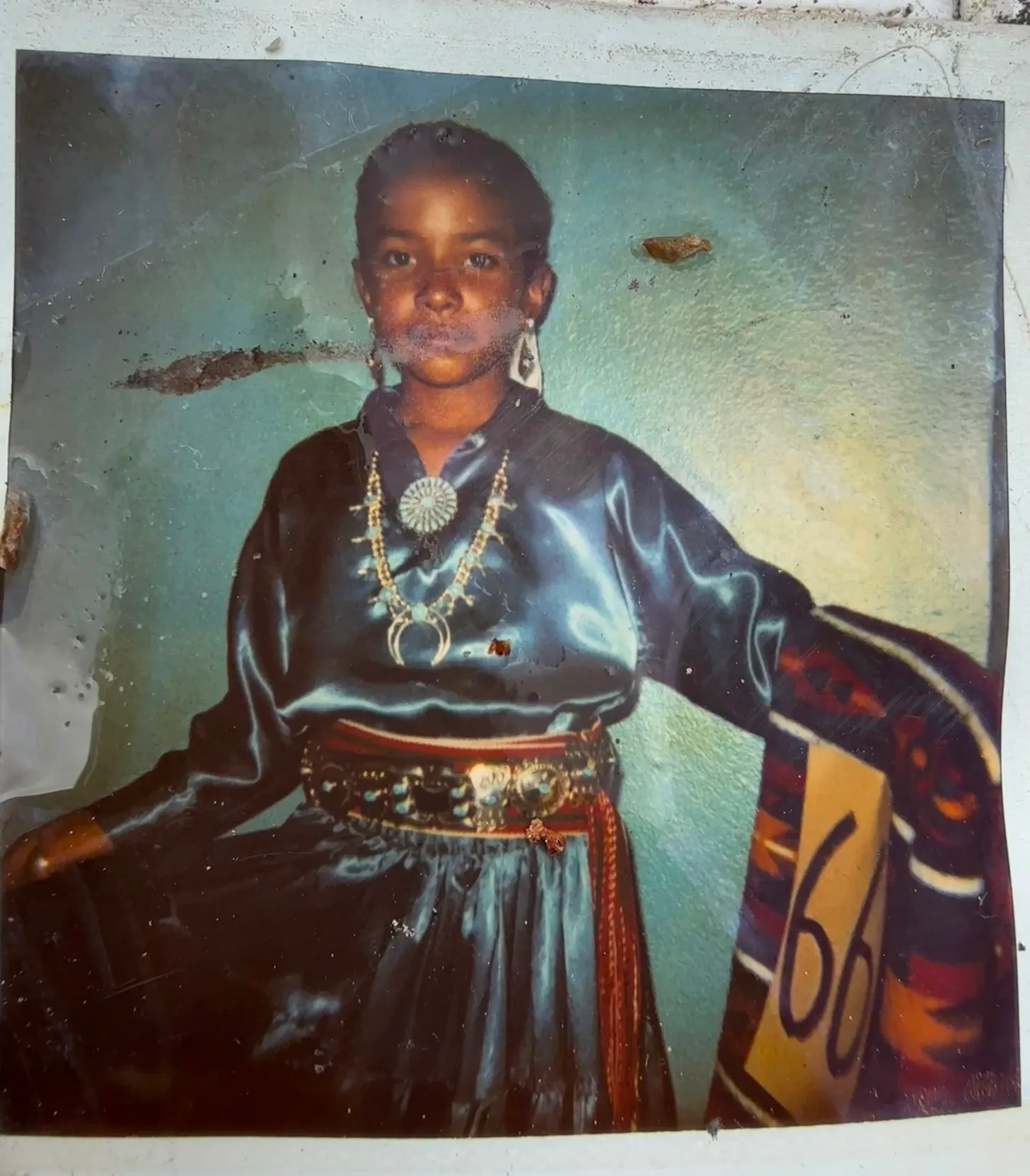
I miss you, Gram. To live in this Fourth World, this Glittering World, plagued by decorum, aching for embodied ritual, ceremony, for Hozho. Still, it is not such a foreign place. It is a bike I remember I can ride. No one can see you, but you are my training wheels. You are holding the back of my seat on that dirt road in front of the house. The bike has no streamers. Walmart didn't sell them.
We are gliding along the red clay. Rez dogs swarming. Sheep grazing over the hill. Corn pollen under your fingernails from sunrise prayers. My hair like the little lambs, you would say; curls catching goatheads and dandelion fuzz.
A Black Rez Girl. A papier-mache doll of stories someone slathered together before I knew words. Murmurs of her truth echoed in dreams and elementary school bios. But blood, ancestry, lineage, DNA (all ephemeral) hovered like crows, doves, hummingbirds. Fleeting vibrations of memory. Trickles of recognition. Wrinkles of light on cradles of identity waiting to be tended to.
Coming home to a soil I once danced on, sang with, and whispered to as a child was a cosmic solicitation to be annihilated, in the best way. It was a call from unseen, familiar, and long-forgotten names. An invitation to die to self. The raw elements of my being were recalibrated, recombobulated. To have a better sense of what this primordial alchemy took, I must start from a day long ago.
But first, context.
My Clans are:
- Tachii'nii nishli (Red Running Into the Water People Clan): mother's maternal clan
- Naahilii bashishchiin (Black): father's maternal clan
- Bilagaana da shicheii (Eastern European): mother's paternal clan
- Naahilii da shinali (Creole): father's paternal clan
- Tseghahoodzanide'e' naasha (I'm from Window Rock, AZ)
I am the first great-grandchild of a Navajo medicine woman and chantway singer, Susie Tapahe. Susie is my middle name. I relish the years when my namesake was earthside with me. For just over two decades, two Susies, two medicine women from the Tachii'nii clan, walked this earth in the Beauty Way, gazing upon the same moons, seeding prayers of praise and grief simultaneously, decades apart in age, tethered together by a single thread: the medicine path.
Gram, you are still weaving with me: through me, alongside me. The wind bellows your melodies. Echoes of your wooden comb, tapping at the loom, hum in my ears. I see your fingertips scouring fresh wool for barbs in my mind's eye. The smell of mutton grease ripe on your chambray blouse.
My mother is Gram's first grandchild. My mother's middle name, Deone, is my surname (without the accent). I am also the great-granddaughter of a Creole Root Worker from New Orleans, Louisiana. She came to South Central LA in the early 1900s during the Great Migration. I am the granddaughter of a Black, Southern, God-fearing woman from Houston, Vergie. She grew up wooing pastors' sons: her wit and fiery demeanor made digestible by her angelic voice.
My bones resound with the knowing that I am an amalgam of all these women, and they are slivers and lifeblood of my being. Innumerable relations (humans, plants, rocks, animals, and otherwise) have shaped my feet, the way those feet navigate the world. As one remembering ancestral habits of cosmogony and belonging, the orientation of clanship that once lay dormant is now a lifeway I carry.
Clanship familiarizes me with land, people, place, culture, language, and disincarnate spirits: plants, animals, and all manner of being. It births me right where I am, steers me, and gently nudges me to choose my path with consideration: to sow, to seed with every action, and to consider the ripples that may emanate from my being.
By the grace of Spirit, a radiant light in my life embodied this way of moving through the world. Diligent, intentional, warm, precise, cunning. Her name is Susie. To us, she is Gram.
It's a warm summer afternoon, 1993. I am five years old, playing on the living room floor of Gram's house. My mom had just finished law school. We moved back home to the Navajo Reservation from Albuquerque. The day is nearly spent. The air is thick and electric. A backdrop of buzzing houseflies accompanies Navajo songs on the radio in Gram's room.
The swamp cooler in the window broke. My brother, Tyler, and I are playing with Hot Wheels on the living room floor. Our shirts are soaked, sweat beading down our foreheads, gathering the red dirt from our skin, pooling at our brows, crusted over by the occasional breeze. We are wearing matching outfits ("outfits made for boys"): blue striped T-shirts, black shorts, and Power Rangers tennis shoes.
Unaware of this at the time, I am a tomboy. I rarely play with dolls, especially Barbies. My mother won't allow it. "Nobody has boobs like that. A woman's body is not curvy like that," she'd say.
The pain of rejection and alienation oozed from her words. What stories were these remarks birthed from? "Shapeless," "boyish," "skinny," "White": all the traceless violations she endured from Navajo kids at school. The poison regurgitated as canon for an eight-year-old, soon-to-be curvy young woman.
What were boobs supposed to look like? Who decided that?
These questions, etched on the side of each Hot Wheels car, raced around the track of my mind. A figure-eight of body dysmorphia, branded onto the blank canvas of a Black girl's budding frame in a land with few reflections of belonging. The curves and a butt blossoming, to my chagrin.
Occasionally, I saw a Barbie at school. Commercials showed girls playing with these svelte figurines. Barbie playhouse. Barbie car. Barbie and Ken. The girl actors, with their blonde hair and blue eyes, pranced these pale-skinned figurines around in make-believe worlds, inside houses with cream walls and white floors.
Girls living in cities with working ACs, screen doors, and no dirt roads. Girls with no fear of mud grasping at every fiber of clothing after rain. Girls whose grandmothers don't hang flowers on the porch to protect the house from lightning during a thunderstorm. Girls whose mothers aren't upset that their curls won't grease down to fit into a tsiiYeel (Navajo bun) for school. Girls who are visited by the tooth fairy and don't have to bury their baby teeth in the ground, giving Mother Earth back what She lent us.
At five, I'd only ever seen Barbies my friends brought to school. Whenever I got a hold of a Barbie, I never cared to dress them up or give them families or a husband. Their lives felt as inert as their plastic skin. With Hot Wheels, however, you were always on the move, on an adventure: escaping a maniac, outrunning a bomb, saving a woman on the tracks, crash-landing into alien landscapes or water where your submarine could shoot missiles at villains.
The Rez was so tiny, and our house so remote. In a way, the universe was in our backyard. Uninhibited by streetlights, sidewalks, or paved roads, the landscape was birthed anew every morning. The novelty unrelenting. This ink cages it somehow. The sheep, the bluebirds, the sagebrush, the big sky, the rain, the corn always inventing new colors.
I was allowed to have one "girl" toy: a Black Cabbage Patch doll.
When I received her for Christmas, I wondered what about her appearance resembled mine. Resemblance, a token of belonging. Man, eternally plagued by the desire to see ourselves in the world, we fashion mini-us's. My tiny hands carrying around a distorted mirror. My family was brown, but I was not. Most dolls were White, but I was not. Was I Black, like her?
In retrospect, I imagine this Black doll was acceptable for me to play with for a few reasons: She didn't have a body I was surreptitiously told to mimic. Her skin was not White. Her eyes were not blue. Her hair was curly and brown, not blonde and straight. Somehow, my mother saw her in me, or me in her. She had a mechanical mouth for eating plastic food. Caretaking is an honorable role to undertake, more essential than playing dress-up, hanging out with friends, or centering your entire existence on the gaze of a man.
This dogma applied to Disney Princess movies as well. "Pocahontas didn't look like that. Native women don't have hourglass shapes like that. Hollywood always has to sexualize women."
The only "girl toy" I was allowed to have was Ariel. Her ethereal, underwater life felt so far from the red clay we lived and breathed; it may as well have been another universe. Ariel's ability to talk to fish or breathe underwater carried no weight in her mysticism. It was her voice. Her voice could cast spells.
Singing is a divination I have carried since birth. I could bring my father to tears. Something moved through me when I sang. I never remembered the sound leaving my lips. I felt more like a flute that Spirit occasionally inhabited, the melody in the air changing course and moving through me. When I sang, I left my body, seeing myself from a distant corner of the room, my head perched next to an entranced relative.
My parents were not singers, or so I thought. It would be much later in life that I learned my mother was the lead singer of a band, Black Sage, when she was in high school. The singers I knew growing up were my grandmothers. They didn't sing pop songs; they sang songs of healing, of praise, of enchantment: medicine songs, songs of the Spirit. They were carrying something, channeling something. Though I wasn't conscious of this, I knew singing was a kind of magic, a spell.
KTNN (the Navajo radio station) plays in Gram's room. She is perched in front of her loom weaving, sitting on an old tree stump. I hear Gram's voice as she sings and weaves. I am put into a trance. I have a toy car in my hand. I rise from the carpet, my body swaying to her words: "Hey-ya-ah. Wey-hey-ya." I keep bouncing. I can't stay still.
I stand, propelling the car through beams of sunlight, dispersing airborne dust. The sweat is a salt lick on my upper lip. Bobbing the car and my body to the beat of the drum, I come to Gram's side, watching attentively as she weaves and sings. Colors escape her lips, swirling around the woven fibers. Her long, steady fingers clasp the tip of a wool weft, drawing the yarn through the warp. Her wooden comb pounces on the top of the threads, over and over. She moves down the full length of the rug.
She starts a new shade of wool. Yanking the fibers apart, she breaks the white wool with a snap of her wrists and begins a new color. At this time, in her late 70s, she had the strength of a brawny man. Gram knew just the right way to manipulate physics and gravity so there was no need to ask for help. If there was something enormous to move, my mother would tell her to wait until an uncle could come over. By the end of the day, Gram had figured out how to get it all done herself. I take after her in this way: a small but mighty pack mule.
Gram begins weaving with an orange sherbet color. "That's the one we made!" I said. "Yes. We got the color just right. With onion, it's very tricky to get the right color because the sun changes it so much. Sometimes, you must dye it over and over again."
Some of this she mutters in Dine Bizaad (Navajo Language), the rest is in English.
Gram was sent to boarding school at 16. A girl, a maiden, a young woman. Her Dine Bizaad frozen in time. A refuge. A relic.
It stings to know just how close I was in those early years to my mother tongue. She was spoken all around me but just out of reach. I imagine my soul lapping up sentences here and there, begging for scraps. Scratching at the pant legs of anyone with a morsel of patience to teach me. Open palms stretched out until Gram had nothing left to give and all at once, it was easier to speak to me in English. Now, I have the Navajo vocabulary of a 3-year-old; left with letters, colors, farm animals, months, numbers up to 10.
"No object is in constant relationship with pleasure," wrote Barthes. "For the writer, however, it is the mother tongue. But what if the mother tongue is stunted?"
Ocean Vuong, On Earth We're Briefly Gorgeous
Sweet 16. How sweet a 16-year-old vocabulary would taste on the mouth with so few reflections of belonging.